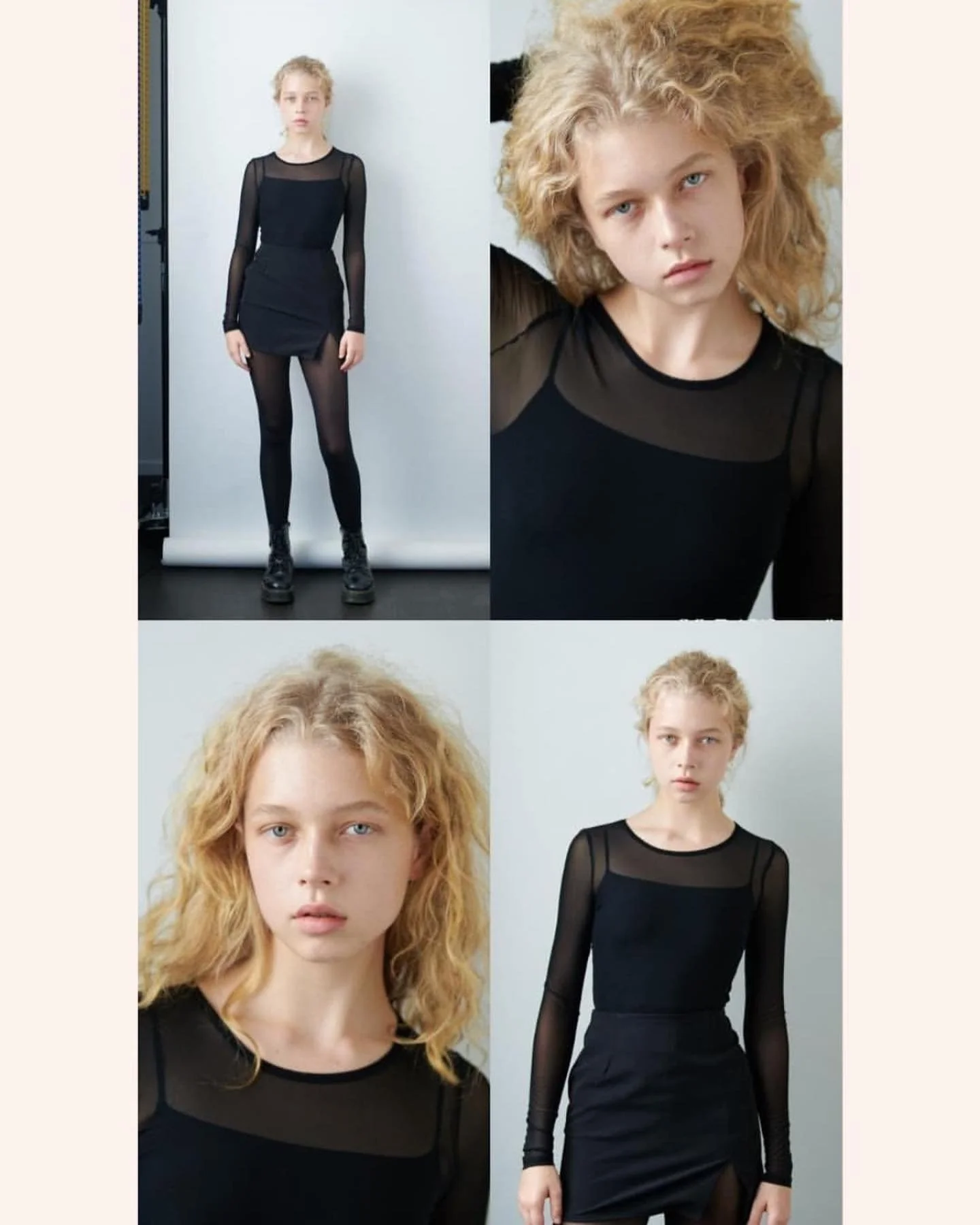
The essentials
- Digitals show your current face and proportions clearly, with simple styling and consistent light.
- Prepare one outfit and bring one change if unsure. Keep hair done but undone, and makeup natural or absent.
- You do not need to know how to model. Direction and reviewing the screen together help you understand what works.
- Follow each agency's current submission instructions, including any no-makeup requirement.
Your digitals may be the first impression an agency has of you. They should make it easy to see what you look like today: your face, your proportions and how you carry yourself.
That sounds simple. Getting the light, framing and small details right still takes attention. You do not need to arrive knowing how to model, and you do not need a dramatic makeover. A little preparation and clear direction go a long way.
Model digitals checklist
Before you shoot:
- Know what the images are for: a first submission, updated representation or a specific request.
- Check the current photo instructions for the agencies you plan to approach.
- Try on your outfit beforehand. Bring one outfit change if you are unsure.
- Make sure your nails are clean and well groomed; I also like to photograph hands.
- Prepare your hair so it looks like you on a good everyday hair day.
- Keep makeup natural or absent. If an agency specifies no makeup, follow that instruction.
- Plan for clear light, a simple background and enough space for full-length photographs.
- Allow time to review the images, rather than rushing through a pose list.
Before you send:
- Choose the views each agency requests and check that they are sharp and current.
- Avoid beauty filters, skin smoothing and changes to your face or body shape.
- Check crops, file sizes and filenames against the submission instructions.
- Include the requested details and send through the agency’s official submission channel.
What are model digitals?
Model digitals, sometimes called polaroids, are straightforward photographs that show your current appearance. They help someone assess you without a styling concept, dramatic lighting or a finished campaign treatment getting in the way.
Are digitals the same as a portfolio shoot?
No. Digitals lighting is deliberately flat and even. It can feel fairly unexciting, almost like making really good passport photos. That is the point: the agency needs to see you clearly without dramatic lighting doing the work.
In a portfolio shoot, I can start to push the lighting and transform how you photograph. Shadow and contrast can bring out a jawline, cheekbones or muscle definition in a way flat digitals lighting will not. If you want to explore that sculpted look, a portfolio shoot gives us room to do it, as can a client booking with the right brief.
Digitals show the starting point. A portfolio explores what you can become in front of the camera. Read more about what agencies need from a model portfolio if you are deciding which to prepare first.
You do not need to be signed to make digitals. For an unsigned model, they can be part of a first application. For a represented model, they can update an agency on how you look now.
Why get a photographer to shoot your digitals?
You can make useful digitals at home. Professional photography is not automatically an application requirement: IMG’s guidance for under-18 applicants explicitly says professional photos are unnecessary. Paying for a session does not guarantee representation.
The reason to work with a photographer is the attention brought to the process. These photographs represent you before anyone meets you. Good light, consistency and someone who can see what needs adjusting can make that introduction clearer.
And sometimes a shoot with your mum turns into an argument about how you are standing before you have made a single useful frame. There is nothing wrong with help from family. But if you are both frustrated, a calm session with someone outside that dynamic can be a better way to work.
Direction is in the small things
When I am shooting, I am looking at details you may not notice while concentrating on the camera:
- What are your hands doing? Are the fingers relaxed, or is tension drawing attention away from you?
- Does your chin need to come up or down slightly?
- Is your hair hiding part of your face, or would moving it help us see you more clearly?
- Are your shoulders lifting as you concentrate?
- Is your stance showing your proportions clearly, or are you twisting without realising?
- Is the expression present and relaxed, or are you holding a face you think a model should make?
There is no single correction that suits everyone. The point is to observe, make a small adjustment and check the result. You do not need to have those answers before the session. I direct you.
Seeing the screen changes the experience
I shoot with natural light directly to my laptop. We can look at the photographs together and see what is working as we go.
A small change to the chin or the position of a hand is easier to understand when you can see both versions. It gives the direction a reason and takes some of the guesswork out of being photographed.
What should you wear for model digitals?
Start with simple, well-fitting clothes that let your proportions read clearly. Try the outfit on before the shoot and check how it sits when standing naturally. If you keep pulling at it or adjusting it, bring another option.
I recommend one outfit change if you are unsure. We can decide on the day what works best. You do not need to pack an entire wardrobe.
For my sessions, I consult with you on wardrobe beforehand so you know what to bring. If an agency has requested a particular view or outfit, mention it then. Clothing and footwear choices should follow the actual brief, rather than a universal rule about what every model must wear.
Simple wardrobe options
For men, a plain T-shirt or singlet with jeans or trousers is a good starting point. For women, the same simple combination works; a skirt is another option if you are feeling bold. Choose black, white or another neutral colour, and keep the fit clear enough to show your proportions.
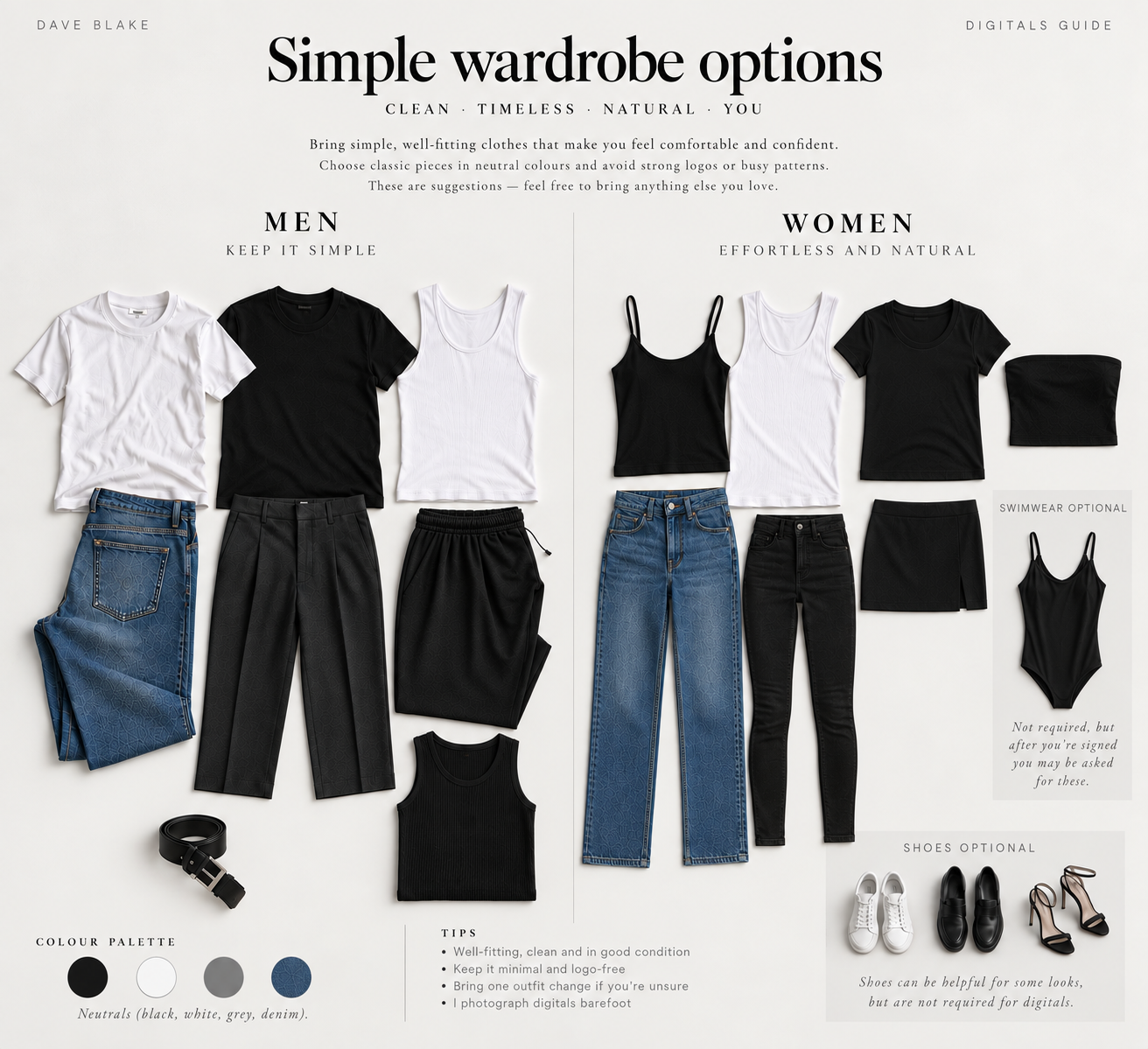
Illustrative wardrobe suggestions. Men’s options on the left; women’s options on the right. Bring one outfit change if unsure. I photograph digitals barefoot.
Barefoot is my preference
I prefer to photograph digitals without shoes. I want to see you as a blank canvas, including your natural stance and proportions, without footwear changing how you stand. That also helps clients assess you for casting. This is my approach, rather than a universal agency rule. If an application specifically requests shoes or heels, let me know beforehand.
Is swimwear required?
Swimwear is not required for an initial-submission session with me. Once signed, your agency may ask for additional digitals in a plain one-piece or bikini, depending on the work they are putting you forward for. Individual agency requirements vary, so check the actual brief.
Men can also choose to add a jeans-only, shirt-off variation. Both swimwear and shirt-off photographs are optional, discussed before the shoot and based on what you are comfortable with. Neither is part of the basic wardrobe requirement.
Hair: done but undone
Aim for “done but undone”. You want to look like you look good when you walk out the door every day, without looking as though you have just left the salon.
During the shoot, I may suggest moving your hair to show more of your face or changing where it sits on your shoulders. The aim is to make your features visible while keeping you recognisable.
Makeup: natural or nothing at all
You do not need a makeup artist for my digitals sessions. Agencies and clients want to see your skin and face as a blank canvas.
My starting advice is to moisturise and brush your eyebrows. If you want a little makeup, keep it simple: lip gloss and a bit of mascara. Your actual skin and features should remain clear.
An agency’s submission instructions take priority. Some require no makeup at all. For example, Why Not Models requests makeup-free photographs. If that is where you are applying, skip the mascara and gloss rather than treating minimal makeup as an exception.
Light and framing: what makes a useful set?
The face needs to be easy to read. Watch for light that leaves the eyes in deep shadow, bright patches across the skin or a background that attracts more attention than the person.
Consistency matters across the set. If every frame has a different colour cast, exposure or camera angle, it becomes harder to compare them. Keep the light and camera position deliberate, and check the full image rather than only looking at your expression.
For a full-length photograph, leave space around the body and include the feet. For a closer photograph, check that the eyes are sharp and the crop has a purpose. Avoid moving the camera very close with a wide-angle view that changes how your features or proportions appear.
Natural light is my preference, but “natural” does not mean any patch of daylight will work. Choosing where to stand and which way to face is part of the photographer’s job.
Which photographs should you submit?
There is no single set to send blindly to every agency. As one example, Why Not Models asks for a headshot, profile, full-body and smiling photograph. Other applications may specify different views, framing or file requirements.
I shoot a range to cover common submission needs. You can then tailor the selection to each agency you approach. A useful working set may include:
| View | What to check |
|---|---|
| Face from the front | Eyes and facial features are clear; hair is not unintentionally covering them. |
| Three-quarter face | Turn halfway between front-facing and profile, so both eyes remain visible and the shape of the face reads clearly. |
| Profile | The side view is clear, without turning back towards the camera. |
| Full length | The whole body is visible; stance, hands and clothing are considered. |
| Smiling expression | The smile feels like you, rather than an expression held under strain. |
| Hands | Hands and nails are clearly visible. Arrive with clean, well-groomed nails. |
| Optional: shirt-off with jeans | For men who want to include this variation. Discuss it beforehand; it is not a basic session requirement. |
| Optional: plain swimwear | A one-piece or bikini for women who want to include it or have a relevant agency request. Discuss it beforehand; it is not a basic session requirement. |
I also like to include hands in the set, so pay attention to your nails when preparing. The optional shirt-off and swimwear photographs are choices we discuss together, not something you need to agree to for a digitals session.
Use this as a preparation guide, then check the actual application. More photographs are not necessarily a better submission.
What happens after the shoot?
After my sessions, I go through the pictures again, remove the unsuccessful frames and export the good ones. Reviewing on the laptop during the shoot helps us make decisions, but I still give the set another look afterwards.
Choosing frames is different from changing your appearance. Digitals should remain an honest reference. Avoid applying a beauty filter or reshaping features before submitting them.
When your files arrive, choose the images that meet each agency’s requirements. Keep the original exports and make any requested size or crop versions separately. Check the upload preview before submitting so an automatic crop has not cut off something important.
Common questions
Do I need modelling experience?
No. You need to be willing to listen, try adjustments and stay engaged. A directed session is a chance to learn how small changes read on camera, not a test you have to pass before arriving.
Can I take digitals on a phone?
Yes, but getting useful digitals on a phone takes more understanding than simply pointing it at someone.
A phone photograph is already processed by the camera software before you share it. Depending on the phone, app and settings, processing and photographic styles can change the way colour, contrast and detail appear. For example, Apple’s Photographic Styles adjust how its camera renders photographs. Not adding a filter afterwards does not necessarily mean you have a neutral-looking image.
Lens choice matters too. An ultra-wide view encourages you to get close, and shooting too close can exaggerate the features nearest the camera. Camera height and tilt can also make your proportions look different. Switching lenses without thinking about your distance from the person will not automatically solve that.
You still need to recognise good light: a face that is clearly lit, visible eyes, believable skin colour and consistency across the set. Bright enough to take a picture is not the same as useful light for digitals.
If you use a phone, avoid beauty effects and dramatic photographic styles, give the person enough space, keep the camera position considered and review the photographs at a useful size. Check whether the face and proportions look like the person in front of you. A phone can work, but the lighting, distance, angle and direction still need attention.
When should I update my digitals?
When your existing set no longer shows your current appearance, or when your agency requests an update. A noticeable change to hair or appearance is a useful reason to check whether the images still represent you. Ask your booker about timing if you are represented.
Should I send the same images to every agency?
Use the same current set as a starting point, then tailor the selection and files to each application. Read the instructions each time instead of assuming the previous agency’s requirements apply.
What if I am under 18?
For my sessions, include a parent or guardian contact so they can be involved in communication and booking. Check the age and parent-consent requirements of any agency you apply to as well.
If you would prefer a guided session
You can use this checklist to make digitals at home. If you would like help with preparation, light and direction, see my professional model digitals sessions in Brisbane for the current inclusions, rate and enquiry details. Either way, follow the requirements of each agency you apply to.